Feminist film historians have made vital interventions in established film history, revealing an ardent desire to deviate from “linear, vertical, or diffusionist models of historiography” by highlighting matriarchs like Alice Guy-Blaché, Lois Weber, Germaine Dulac, and Dorothy Arzner, whose contributions defy assumptions about the early film industry.! The Women Film Pioneers Project (WFPP), led by Jane Gaines, Radha Vatsal, and Monica Dall’Asta, investigates women pioneers’ working conditions and achievements worldwide.? While Kiki Loveday questions the Eurocentric origins of the “pioneer paradigm,” she encourages multicultural perspectives and urges us to explore further how the past can challenge or influence the power dynamics of the present.? As film historians working in Asia, we appreciate WEPP’s inclusion of figures long forgotten because of their gender, race, and intercultural or multicultural status. The internal links within each article or profile entry enable users to navigate easily between cross-referenced individuals, countries, and films. The project’s open access aligns with the idea of constructing a gendered “world cinema” or a public domain of global women’s cinema.4
Following the above inquiries and combining cross-cultural and trans-lingual comparative analysis with gendered historiography, this essay examines three women whose film careers overlapped before and during World War II: Dorothy Arzner (1897 – 1979), the only female director early in Hollywood’s sound era between 1929 and 1943; Sakane Tazuko (坂根田鶴子) (1904 – 1979), Japan’s first female director and the only one until 1953; and Esther Eng (伍錦霞) (1914 – 70), the first woman to direct talkies in China and Hong Kong and the first Chinese American woman to produce a film in Hollywood. While Arzner has been extensively studied since her rediscovery in the 1970s, research on Sakane and Eng has been limited because of lost films. However, it is expanding with advances in media archaeology and “cine-feminism.”5
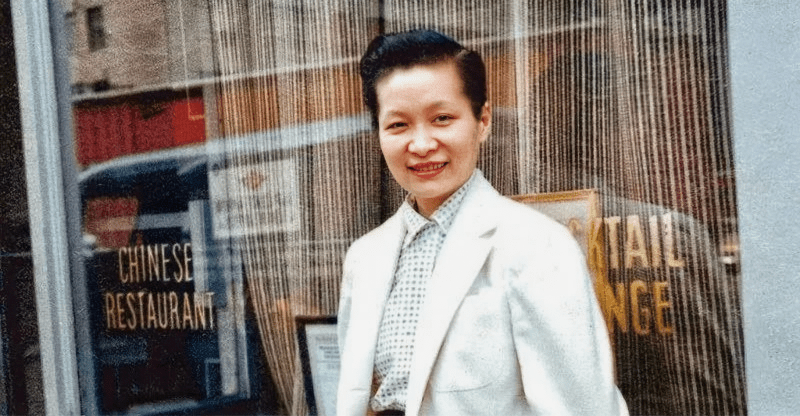
Taking advantage of digitized periodicals from the twentieth century, we will investigate three main areas. First, before entering the film business, all three women were from well-to-do families and shared a passion for cinema. Their fathers’ connections helped them land their first positions, but they took the director’s chair and sustained their careers for over two decades through their own wisdom and efforts. What were their working conditions like? How did they succeed? What challenges did they face as female directors? Second, the US joined World War II in December 1941, but Japan and China were in wars from 1931 to 1932 and 1937 to 1945. All three women were unavoidably engaged in wartime propaganda production to different degrees. How does the gender-nation dynamic present itself in their films? Did such propaganda work help them elevate their careers? Third, when their photographs are juxtaposed (fig. 1), we cannot help but be amazed by the resemblance in their hair and clothing styles, which signaled their queer identities. Did the journalists of their time find out about their queerness? If yes, how were they described? Were their personal lives exposed in the press? Historical evidence suggests that all three women lived as open (or not wholly closeted) lesbians. By drawing on queer historiographical methods, especially Judith Mayne’s close readings of press reports on and unpublished photographs of Arzner, we examine how the gender fluidity of Sakane and Eng provided opportunities and posed challenges for their film careers. Using Arzner as a benchmark when examining Sakane’s and Eng’s careers and achievements, we also hope to shed new light on Arzner’s impact in Asia.
A tribute to pioneering women directors, featuring Esther Eng, outlining her significant contributions to the film industry. Movie Poster courtesy S. Louisa Wei.
If someone asked you if you are a feminist, would you immediately answer “no”? If someone asked you if you support feminist movement, would you immediately answer “yes”? Although most people are theoretically in favor of gender equality, in the minds of many, ‘feminism’ may not be an entirely positive label, and may be perceived by some as ‘man-hating’ and anti-mainstream. The film “Feminist Voices”, which was invested by the British Film Institute (BFI) and other organizations with an investment of 14 million US dollars and tells the story of how women gained the right to vote in the United Kingdom, has entered the top ten of the local box office in three days after its premiere in Hong Kong on November 12, and is currently still ranked in the top ten or so, and has already recouped its investment at the global box office. In 2015, when the prospect of universal suffrage in Hong Kong is uncertain and the five Chinese feminist sisters were arrested for no apparent reason, The Feminist Voice has at least a double meaning for us.
The struggle for women’s right to vote has played an important part in the history of women in every country, so all stories about the struggle for the right to vote have a global dimension. The central character of the film is Carrie Mulligan’s Maud Watts, a 24 year old laundry worker, whose characterization is based on that of hundreds of lowly women workers, and whose fate is a combination of many: she was born in a laundry factory without ever having met her father, lost her mother at age 4, started working part-time at age 7, began working full-time at age 12, and rose to become a laundry crew chief at age 20. The son belongs to her husband. By choosing this young woman as the main character, viewers who do not know much about the social situation at that time will have the opportunity to see from her life and point of view the exploitation and disrespect that women faced, the reasons for the destructive actions of the members of the Panchayat Party, and how the police violently dispersed the gathering of women after they had been deceived by the government officials. Once Maud begins to yearn for a life equal to that of men, she is arrested after her first action and is immediately expelled from her home by her husband, who later even gives her son away. When she became homeless, her fellow activists helped her to survive and showed her that the fight for women’s rights knew no boundaries. Later, an official lures her to become an undercover agent, but she remembers Emmeline Pankhurst’s goal of being a rebel rather than a slave, and does not betray her companions or deviate from her original goal.
Two of the movie’s supporting characters are real people in history. One is a confidante of Emmeline Pankhurst (1858-1928), the leader of the women’s suffrage movement in England. After learning about social movements through her parents, she organized the Women’s Social and Political Union after her marriage, and with the support of her lawyer husband, who was 24 years older than her, she became a leader of the suffrage movement. As all peaceful petitions and proposals were ignored, she called on members of her organization to force the government to accept women’s demands by means of rallies, disruption of communication systems, and hunger strikes in prison. Another was Emily Davidson (1872-1913), a confidante of Emmeline Pankhurst, who was imprisoned nine times and force-fed 49 times for her hunger strikes. At the 1913 Annual British Jockey Club, she walked up to King George V’s horse and attempted to tie a silk scarf reading “Women’s Suffrage” onto the horse, but was run over and killed by the galloping horse. The event was covered by the national press and the Women’s Social and Political Union organized her funeral, which was attended by hundreds of members and thousands of Londoners. When World War I broke out shortly thereafter, Pankhurst decided to suspend action in favor of Britain’s entry into the war, and British women had the opportunity to demonstrate their ability through active channels, and finally gained partial (over-30) suffrage in 1918, at the end of World War I. It took another decade for them to actually gain the right to vote at the age of 21, just as men did.
Sundream Motion Pictures, the company that distributed Suffragette in Hong Kong, advertises the film as “a new world of work with a new set of Academy Award winners,” but neglects to mention that the film’s creators are also a strong female cast: director Sarah Gavron, screenwriter Abi Morgan, and producers Alison Owen and Faye Ward, all of whom are accomplished female filmmakers. Ward produced Jane Eyre (2011) and Irving produced Elizabeth (1998). Director Gavron, the daughter of a British printing tycoon and former Deputy Mayor of London, began her career as a documentary filmmaker, and won the BAFTA and BAFTA for Best Director in her feature film debut, Brick Lane (2007). After graduating from university, screenwriter Morgan worked in the catering industry serving Mrs. Margaret Thatcher; twenty years later she wrote the screenplay for the biopic The Iron Lady. Among her adaptations is the award-winning The Hours (2002), which brings together Virginia Woolf, a British writer living in 1923; Laura Brown, a housewife in 1951 Los Angeles; and Laura Brown, a woman living in 2001 New York City and a lesbian editor living in New York City in 2001. The story of the three women’s destinies in three different time periods is perfectly woven together by the coincidence of the three women’s destinies and their careers.
The two producers had already booked the writer and director to collaborate on Suffragette in 2011, but it was only in February 2014 that funding was secured and filming began. The film stars Streep as Pankhurst, Mulligan as Maud, and Helena Bonham Carter as a radical activist supported by her pharmacist husband. In the role of this fictional character, Carter modeled her character after Edith Garrud (1872-1971), a female martial artist who trained bodyguards for the Women’s Social and Political Union. Her great-grandfather, Asquith, was the Prime Minister of the United Kingdom and opposed women’s right to vote, so Carter’s involvement was intentional. The fact that the BFI was able to finance the film and give it to a female director, producer and screenwriter, and that the British Parliament even lent its interior locations for the first time, is the envy of female filmmakers elsewhere in the world!
Today, men who are unwilling to openly support women’s rights can only say that they have a long way to go before they have a true sense of democracy, and it is incumbent upon all women to understand how our great-grandmothers and grandmothers fought with will and sacrifice for all the human rights and civil rights that women enjoy today. At the end of Suffragette, there is a long sequence of women’s access to the vote in various countries, in which we see that in New Zealand it was 1893, in Russia it was 1918, and most countries in Europe and the United States achieved equal voting rights for both men and women shortly after the end of the First World War; and underneath the year 1949, China and India are written in bold letters. In India, women still live under the threat of rape and violence, while in China, “gender equality,” which seemed to have been solved by a single statement (that “time is different now, men and women are the same”) from Chairman Mao Zedong and a few laws in the New China, seems to be in great peril today. Gender equality, like democracy, is an awareness that once awakened, there is no turning back. We should all follow Maud’s example and do our part for a life free from slavery and for the happiness of the next generation.
There is only one scene where Streep plays Pankhurst in Suffragette, but it is one of the highlights of the movie, which is a speech at a women’s rally, and it is said that Streep’s impersonation of Pankhurst can be taken for real. As a feminist pioneer, she is naturally asked if she is a “feminist,” but she calls herself a “humanist,” to the dismay of many feminists. We remember earlier this spring at the Oscars, when Best Supporting Actress Patricia Arquette took the opportunity of her acceptance speech to attack the grossly sexist nature of Hollywood paychecks, Streep immediately stood up and applauded. In September, she also personally enlisted members of Congress to support affirmative action, and later funded a campaign to encourage women over 40 to write their first screenplays. After all these actions, her retention of the term feminism is worth pondering.
After watching Suffragette, I totally agree with Shek Kei’s comment that the movie demonstrates “backbone and integrity”, and also agree with the distributor’s tagline “Awaken from your destiny, be your own master”. Thinking of the figures on the streets of Hong Kong at this time last year, I believe they can all be inspired and encouraged by this calm and cool movie.
Citation: S. Louisa Wei. “Suffragette: The Awakening from Women’s Fate” [魏時煜,《從認命中覺醒的〈女權之聲〉》]. Mingpao Daily News 明報, 2015-11-23, D4.





 On Women's Cinema